Human tissue models
Bioengineered neuromuscular systems for function, aging and precision medicine.
We use bioengineered human muscle and neuromuscular systems to follow cellular state through to tissue function. These models allow aging, sarcopenia and treatment response to be studied in a controlled human context while functional, imaging and molecular measurements are made on the same tissue.
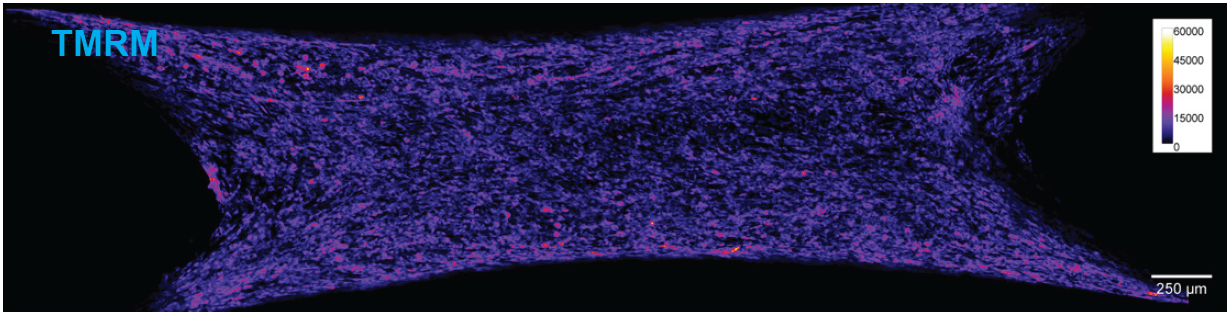
Mitochondrial membrane potential across a bioengineered human muscle construct. Lab image.
Current directions
Motor neuron–muscle co-cultures
We are engineering motor neuron–muscle co-cultures to study neuromuscular communication, tissue maturation and the loss of coordinated function in aging and disease.
Functional analysis of muscle
Functional phenotyping, including contractile force measurements, is combined with quantitative imaging and molecular profiling, so that tissue architecture can be read against performance.
Precision models of sarcopenia
We are developing multiplexed assays that report functional and molecular outcomes side by side across patient-relevant models. A central application is sarcopenia, where these systems can support mechanistic studies and the evaluation of differential treatment responses.